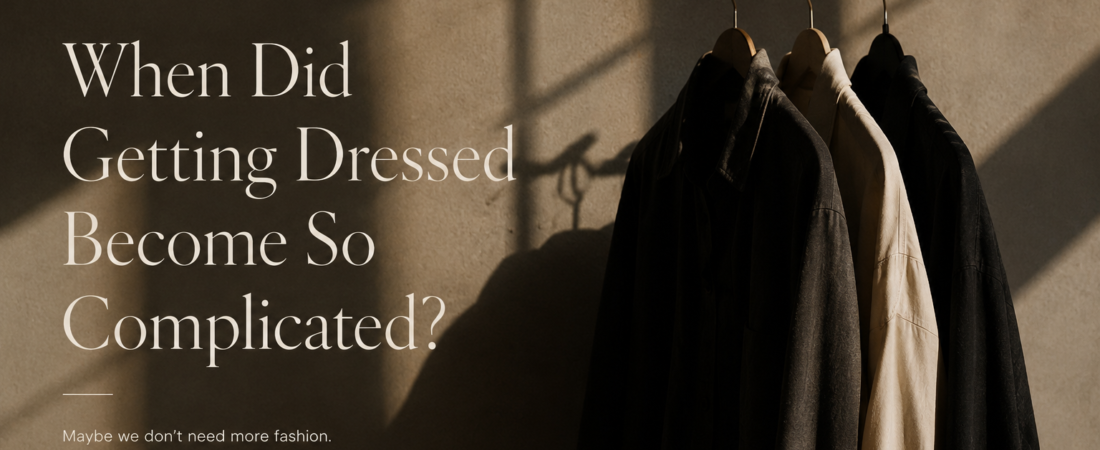
When Did Getting Dressed Become So Complicated?
Maybe we don’t need more fashion. Maybe we need to remember why we started wearing it in the first place.
There was a time when getting dressed was just getting dressed.
You opened your wardrobe.
You picked something.
Maybe you changed your mind twice.
Maybe you wore your favourite shirt again even though you’d already worn it three days ago.
And then you left.
No aesthetic.
No “core.”
No trend report telling you what your outfit said about your personality.
Just clothes.
Somewhere along the way, it became a little more complicated.
Now you can wake up and discover that your wardrobe is apparently supposed to have a personality.
Maybe you’re clean girl.
Maybe you’re old money.
Maybe you’re streetwear.
Maybe you’re quiet luxury.
Maybe you’re something you didn’t know existed until the algorithm introduced you to it yesterday.
And by the time you’ve figured that out, there’s already something new.
It sounds ridiculous when you say it out loud.
But we’ve all done some version of it.
We have never had more inspiration.
And somehow, it has become harder to know what we actually like.
Open Instagram.
Save an outfit.
Open Pinterest.
Save another.
Watch a video.
Save another.
Someone wears something you’ve never considered before, and suddenly you want it.
Not because you sat down and decided:
This is me.
You just saw it enough times that eventually it started feeling familiar.
And familiar can be surprisingly easy to mistake for personal.
There is a strange contradiction happening in fashion right now.
We have more access to individuality than ever.
We can see how people dress in Tokyo, Mumbai, Seoul, London, Copenhagen, New York.
We can discover vintage pieces, independent designers, tiny labels, old photographs, forgotten subcultures.
We can mix everything together.
Yet somehow, the internet can make all of us look like we’re shopping from the same invisible wardrobe.
Recent research on Gen Z fashion describes this tension directly: social media and trends strongly influence how young people construct and communicate identity, while there is also an emerging desire for individuality and uniqueness.
Maybe that’s why the conversation around fashion is changing.
People are getting tired.
Not necessarily tired of clothes.
Tired of being told what is next.
Because how many “new” things do we really need?
A new aesthetic.
A new silhouette.
A new colour.
A new must-have.
A new way to wear something you’ve already seen a hundred times.
Fashion used to change.
Now it updates.
And there is a difference.
Change can happen naturally.
An update asks you to keep up.
Current fashion coverage is already noticing this fatigue. In 2026, the conversation has increasingly shifted toward longevity, versatility, repetition and more personal forms of dressing rather than endlessly chasing micro-trends.
And honestly?
Maybe repeating an outfit isn’t boring.
Maybe knowing what you like is the opposite of boring.
I think we’re asking the wrong question.
We’re constantly asking:
“What’s trending?”
Maybe we should ask:
“What feels like me?”
They’re not the same question.
One looks outward.
The other looks inward.
One asks you to keep up.
The other asks you to pay attention.
And that second question is harder.
Because you might discover that you don’t actually want the thing everyone is talking about.
You might like the jacket from five years ago.
You might wear the same trousers until they’re almost falling apart.
You might like black.
A lot.
You might like colour.
A lot.
You might change your mind next week.
That’s okay too.
Personal style doesn’t have to be a perfectly curated identity.
It can be a work in progress.
Maybe that’s what fashion was always supposed to be.
Not a set of instructions.
Not a personality test.
Not a competition to see who discovered the next trend first.
Just a way of making a choice.
A small one.
Every morning.
Sometimes the choice says something about you.
Sometimes it doesn’t.
Sometimes you dress up because you feel good.
Sometimes you dress down because you couldn’t care less.
Sometimes you wear something because your friend gave it to you.
Sometimes because you found it in your mother’s wardrobe.
Sometimes because you saw something on the street and thought:
I want to try that.
That’s all part of it.
Influence isn’t the enemy.
Losing the ability to choose is.
So maybe we don’t need to escape fashion.
Maybe we just need to stop letting it speak louder than we do.
Take inspiration.
Borrow ideas.
Change your mind.
Wear the trend.
Ignore the trend.
Repeat the outfit.
Break the rules.
Make mistakes.
Find something that feels strangely, inexplicably yours.
And when someone asks:
“Where did you get that idea?”
Maybe the best answer isn’t a brand name.
Maybe it’s:
“I don’t know. It just felt like me.”
This is where AANS begins.
Not with the promise of having all the answers.
But with questions worth asking.
Who decided what looks good on you?
Are you actually original?
What happens when you stop dressing for everyone else?
We’re interested in that space between influence and individuality.
Between what already exists and what could exist next.
Because we don’t think fashion needs to tell you who to be.
We think it should give you room to find out.
So, let’s make this personal.
Tomorrow morning, before you get dressed, don’t open Instagram.
Don’t check Pinterest.
Don’t look at what’s trending.
Just open your wardrobe.
Pick the first thing you genuinely want to wear.
Then ask yourself:
Why this?
Not because it’s fashionable.
Not because someone else wore it.
Not because you think it looks good on you.
Just:
Why did I choose this?
Maybe you’ll have an answer.
Maybe you won’t.
Either way, we’d like to hear it.
Tell us your answer.
What is one thing in your wardrobe you keep wearing — and why?
Share it with us:
#AANSJournal
And if you want, tag @AANS.
We might feature some of the answers in our next Journal.
Welcome to AANS Journal.

Leave a Reply